The short answer for a leak you cannot see
Turn off every tap and appliance, read your water meter, wait two hours without using any water, then read it again. Per the EPA, any movement at all on the meter means a probable leak. Then test each toilet by tinting the tank water with food coloring.
If both checks point to a leak but you cannot see wet drywall, stains or puddles, the leak is hidden in a wall, a slab or a buried line. That is when electronic detection saves you from cutting open the wrong spot. You can reach our 24/7 dispatch at (562) 488-9614 at any hour.
Run the meter test in about ten minutes of work
The test itself takes two hours, but your hands-on time is short. Pick a stretch when nobody is home or everyone is asleep.
- 1
Shut off everything that uses water
Close all taps, stop the dishwasher and washing machine, and pause any irrigation timer. Make sure nobody flushes.
- 2
Find and open the meter box
Most meters sit in a ground-level box near the curb or the front of the lot. Lift the lid and wipe the cover so the dial is readable.
- 3
Look at the leak indicator
Many meters have a small spinning triangle or star. If it turns while the house is fully shut off, water is leaking somewhere on your side of the meter.
- 4
Wait two hours and compare
Take a photo of the full register now and another after two hours of zero use. Any change in the numbers is the EPA's signal for a probable leak. If nothing moved, your plumbing is likely tight at least under normal pressure.
- 5
Close the main valve and look again
If the dial moved, shut your main valve and watch the indicator. If it stops, the leak is inside the house. If it keeps turning, the leak is between the meter and your main valve, which points to a buried line.
What the meter and dye results usually point to
Use this as a sorting tool, not a diagnosis. The right column is where a technician would start looking.
| What you see | Likely area | Next move |
|---|---|---|
| Meter moves, stops when main valve is closed | Inside the house | Dye test the toilets, then check under sinks and at the water heater |
| Meter moves even with main valve closed | Between meter and house | Book line testing for a buried leak |
| Dye shows in bowl after 10 minutes | Toilet flapper or fill valve | Replace the flapper or have the toilet repaired |
| Meter is still, but bills are high | Usage or irrigation | Check sprinkler zones and look at past bills |
| Warm spot on floor, hot water running slowly | Hot line under a slab | Ask for electronic detection before any floor work |
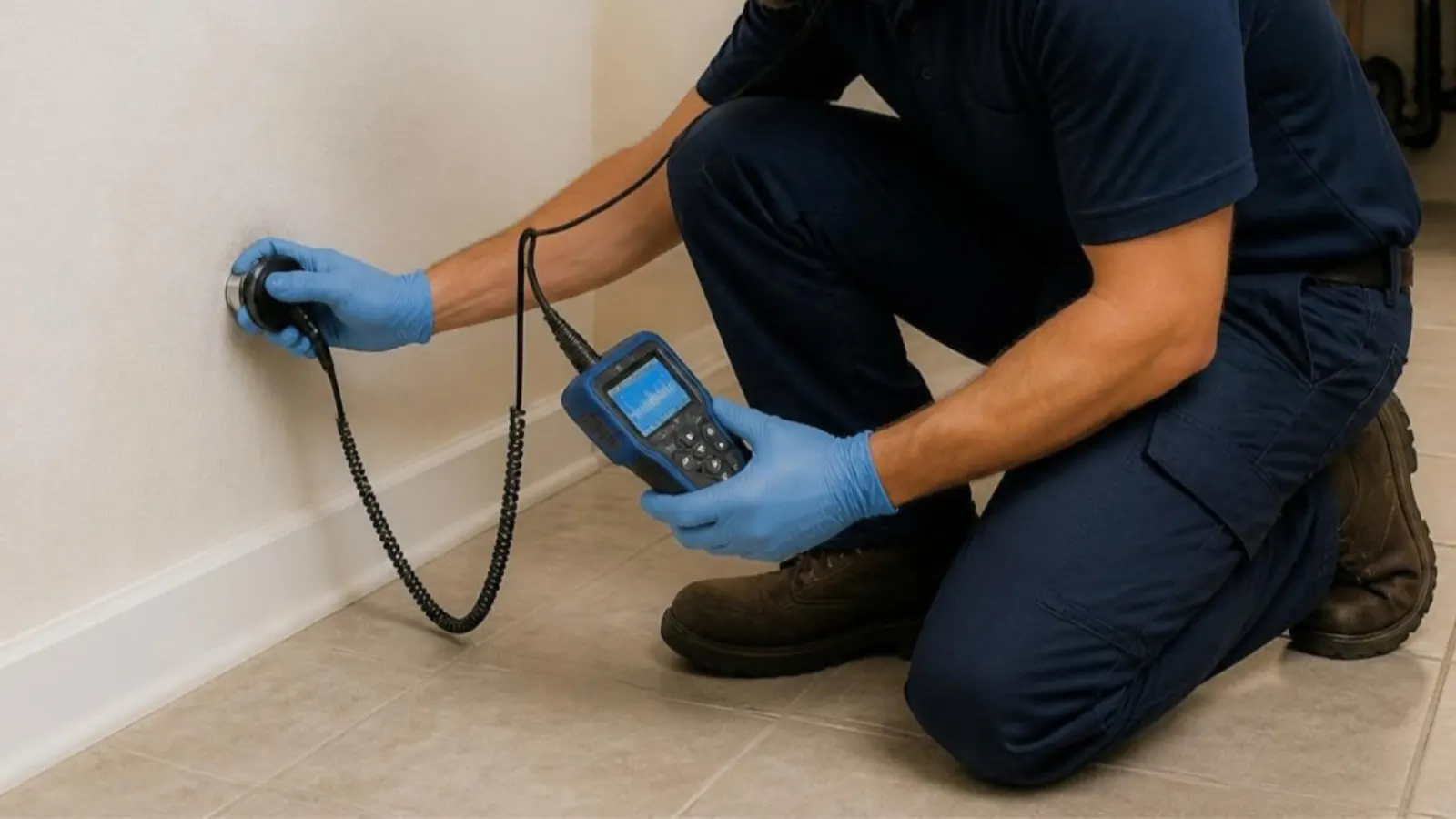
Hot-spot floors and sounds of running water behind walls are the classic reasons to move from DIY checks to listening gear.
Meter moved and you cannot find why?
Tell us what the dial did and which toilets passed the dye test. Our dispatcher will help you decide whether it is a quick fix or a job for listening gear.
Why small leaks are worth chasing
The EPA's Fix a Leak Week page says the average household leak can lose over 9,300 gallons yearly, and nine percent of homes have leaks losing 50 gallons or more per day. Fixing easily corrected leaks can save about 10 percent on a water bill.
The same page gives a few quick yardsticks. One drip a second from a faucet adds up to over 3,000 gallons a year, while a sprinkler leak only 1/32 inch wide can lose about 6,300 gallons in a month. A family of four using more than 12,000 gallons in a colder month may have serious leaks.
Do the toilet dye test properly
Toilets are the most common silent leaker and the easiest to test. The EPA method takes about ten minutes.
- Lift the tank lid and set it somewhere safe.
- Tint the tank water with a few drops of food coloring and do not flush.
- Wait 10 minutes and look in the bowl without touching the handle.
- If color appears in the bowl, the flapper or fill valve is leaking.
- Flush right afterward so the dye does not stain the bowl.
- Repeat for every toilet, since one bad flapper can hide behind a good one.
- The EPA suggests replacing a flapper at least every five years.
A failed dye test is usually a cheap fix, and our Toilet Repair crews handle it along with running and rocking toilets. If every toilet passes and the meter still moves, call (562) 488-9614 and describe what you saw.
Pico Rivera water and housing: what it means for you
Pico Rivera's city website explains who serves your tap. Water comes from the City Water Division at 6615 Passons Blvd, (562) 801-4316, in the city-served area, and from Pico Water District at 4843 S. Church St, 562-692-3756, outside it. The page has an address lookup map where green means City and red means Pico Water District.
That matters for the meter test, because the utility that owns your meter is the one to ask about meter problems and the meter-side valve. Look up your address on the city page before you start, then call the right office if the dial behaves strangely. Anything past the meter is your plumbing and your repair.
When to stop testing and call for electronic detection
Do-it-yourself checks tell you that you have a leak. They rarely tell you where. These are the situations where gear beats guessing.
Meter moves with the main closed
That points to the buried line between meter and house. Pressure testing and acoustic listening can pin the spot so the trench is short instead of long.
Suspected slab leak
Warm floor patches, a hum behind a wall or damp carpet near an exterior door suggest a pressurized line under concrete. A slab leak needs tracing with listening and thermal tools. Our Slab Leak Repair page explains the repair choices.
Bill jumped and the toilets pass
Irrigation, a leaking hot line or a failing supply valve are common suspects. Our Leak Detection service works through them in order instead of tearing into walls.
If the leak is outside the house
A leak on the service line between the meter and the home often shows up as a soft patch in the lawn or a damp strip along the driveway. Your own meter test already told you it is out there. The repair is a trenching or pipe replacement job, covered on our Water Line Repair page.
Neighbors in Montebello and Norwalk run into the same pattern in older streets. If water is pooling and you cannot stop it, shut the main valve and call (562) 488-9614 so a crew can come out after hours.
Standards and sources behind this page
The meter and dye tests come from EPA WaterSense Fix a Leak Week guidance. Provider information comes from the City of Pico Rivera.
Questions we hear most
The EPA method is to read the meter, wait two hours with no water use, and read it again. A changed number in that window points to a leak. Longer, like overnight, gives a clearer reading for very slow leaks.
Look at irrigation, since even a small sprinkler leak runs all month, and compare the bill dates with guests, new fixtures or seasonal use. If the pattern still makes no sense, ask for a Leak Detection visit and bring a recent bill.
Use the address lookup map on the city's website. Green means the City Water Division, red means Pico Water District. If the map is unclear, the Water Division at (562) 801-4316 can tell you which utility bills your address.
Not as a first step. Detection uses listening gear, moisture readings and thermal imaging, so any opening is small and placed with a reason.
Close the main valve if water is escaping, move valuables away from wet areas and keep electrical items out of puddles. Our line is open 24/7 at (562) 488-9614.
Ready for someone to trace it?
If the meter test or the dye test turned up a leak, Pico Rivera Express can find the exact spot and give you a clear price before work starts. Dispatch runs around the clock.