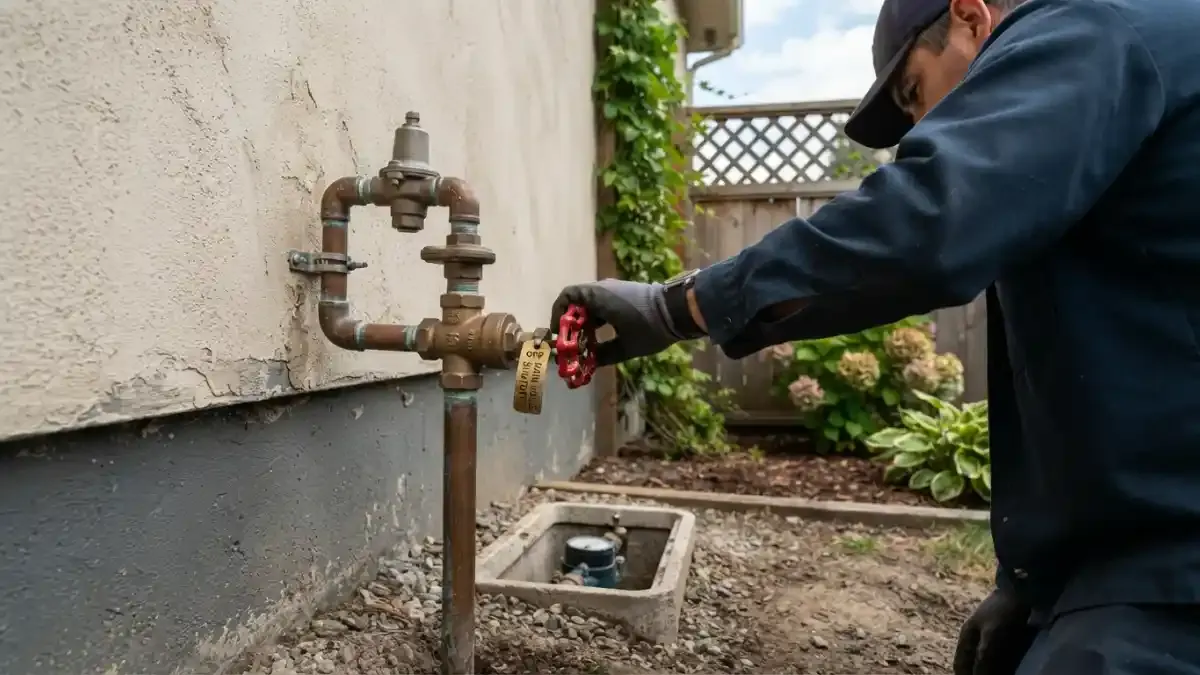
The valve to find before you ever need it
Your home usually has a main shutoff valve where the water line comes in, and a second valve at the meter that belongs to the utility. The house valve is yours to operate. Turning it off cuts water to every fixture inside.
If water is already escaping, close the main valve, switch off power near wet areas and call (562) 488-9614. Dispatch never closes, so a crew can start on the burst while you keep the water off.
Where to look for it
Locations vary by house, so check these spots in order.
- Along the front wall of the house, near where a hose bib sits.
- Inside a garage, often on the wall closest to the street.
- Near the water heater or in a utility closet.
- In a basement or crawl space if the house has one.
- Outside in a box near the foundation or the meter, with a small cover.
- Behind an access panel in a hallway or laundry room.
- At the meter box, where the utility's valve sits next to a separate valve on your side.
If you cannot find it after a walk around, trace the pipe backward from the water heater or a hose bib toward the street. Still stuck? Call (562) 488-9614 and we can help you locate it during a visit.
Ball valve or gate valve
The handle tells you which kind you have. The type changes how you test it and how likely it is to fail.
| Ball valve | Gate valve | |
|---|---|---|
| Handle | Lever, quarter turn | Round wheel, many turns |
| Closed position | Handle crosswise to the pipe | Wheel turned fully clockwise |
| Typical age | Newer installs | Older homes |
| Common problem | Handle gets stiff, seldom fails inside | Stem corrodes, gate may not seat or may break |
| Test method | Quarter turn and back | Turn slowly, a half turn at a time |
| Replacement | Straightforward | Often best replaced when stuck |
If you have a round wheel, treat it gently. A forced old gate valve can break and leave you with no shutoff at all.
Stuck valve or a leak right now?
If water is escaping and the valve will not close, call straight away. We can reach the line at the meter or work around it.
How to test and exercise the valve
Do this once a year. It takes five minutes and shows you whether the valve will work when it matters.
- 1
Warn the house and open a faucet
Open one cold tap at the lowest point of the house, such as an outside hose bib. That way you will see the flow stop when the valve closes.
- 2
Turn the valve slowly
For a lever, a quarter turn closes it. For a wheel, turn clockwise a bit at a time. Never force it.
- 3
Confirm that the water stops
The tap should dwindle to a trickle and stop. If it keeps flowing, the valve is not closing fully.
- 4
Open it again and check for drips
Turn it back all the way open, then wipe around the stem. A wet stem or packing nut means the valve is wearing out.
- 5
Label it
Hang a bright tag on the valve saying which way is closed. Tell everyone in the house. The best time to learn it is not at 2 a.m.
Pico Rivera water and housing: what it means for you
Who owns the valve at your meter depends on who serves your address. Pico Rivera's own provider page splits the city between the City Water Division, (562) 801-4316, and Pico Water District, 562-692-3756, which covers addresses outside the city-served area. We cannot see from the street which one has the valve at your meter.
So ask your utility about the meter valve. The valve at the meter is theirs, and they can tell you who is allowed to operate it. Your house valve is the one to use in an emergency. Our own Burst Pipe Repair crews can work from a closed house valve.
If the valve will not turn
A stuck valve is common after years without use. Do not reach for a pipe wrench.
Try gentle back and forth
Work the handle a few degrees each way to break up deposits. Small motion first, then a little more.
Check for damage
Look for a bent handle, a cracked stem or a leaking packing nut. If any of these show, stop and call.
Do not use a cheater bar
Extra force can snap the stem inside the body and make the leak worse.
Plan a replacement
A valve that will not close is a risk. Replacing it is a short job, and it can be combined with other work such as Plumbing Installation.
Why older homes should check sooner
Census ACS 2024 figures put the median year built in Pico Rivera at 1957, which means plenty of houses may have older valves. Time does not make a valve fail, but years of sitting open do tend to freeze them. A yearly exercise keeps the stem moving.
Nearby towns show a similar mix. Median years built are 1963 in Montebello and 1957 in Commerce. In all of them, a valve that closes cleanly can cut a flood to a puddle.
Standards and sources behind this page
Provider information comes from the City of Pico Rivera's service provider page, and valve care follows the valve maker's guidelines.
Questions we hear most
Commonly where the water line enters the house, such as a front wall, garage, utility closet or crawl space. Look near the water heater or trace the pipe from an outside hose bib.
Once or twice a year. Close it, open it, and look for drips at the stem.
The meter valve belongs to the utility. Use your house valve if you can. If you cannot, call the utility and then call us.
The valve is worn and not sealing. That means you do not have a reliable shutoff, and it should be replaced.
Replacing a main valve means shutting off water at the meter or another point, cutting pipe and making new joints. Most homeowners are better off with a plumber.
Ask your water utility, which is the City Water Division or Pico Water District, based on where you live. The lookup map on the city's provider page shows which one serves you.
Yes. Our dispatch runs 24/7 at (562) 488-9614. Close the valve if you can, then call.
Know your valve before the flood
Pico Rivera Express can find, test or replace your main shutoff. You get a clear price before work starts.